When Deeper Isn't Better
 Beth Jones

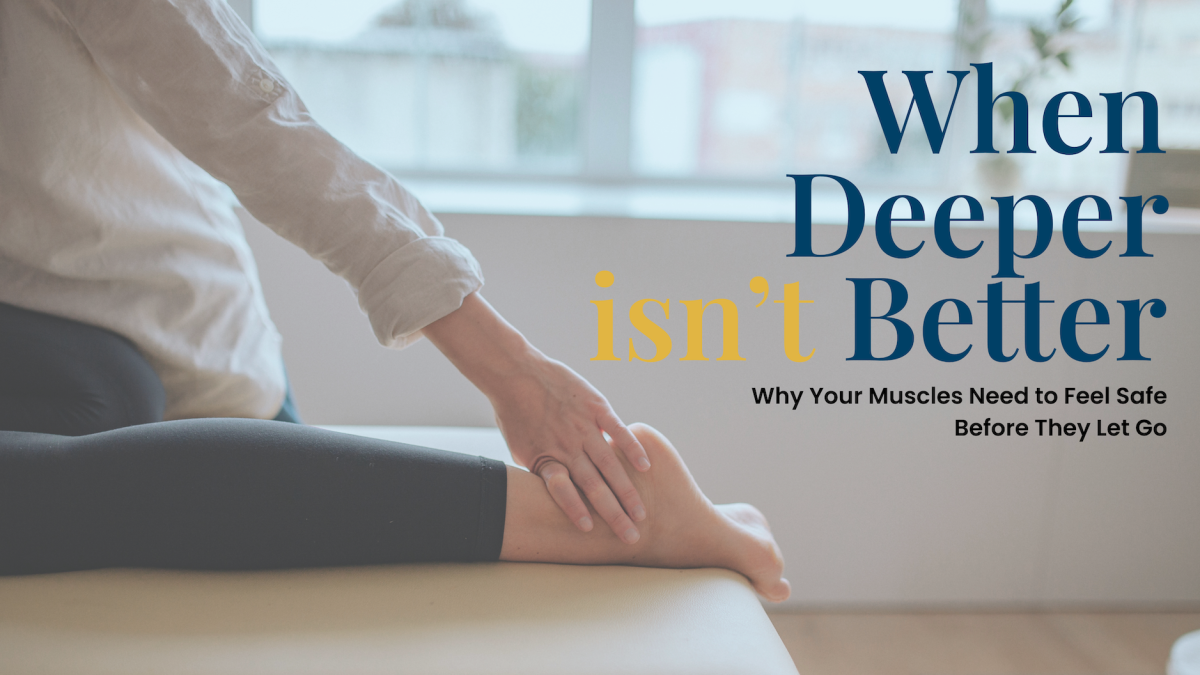
One of my long-time clients came in today for her monthly massage. She's an active woman in her 60s, and uses massage as maintenance to combat the aches & pains that come up. Usually we do a lot of deep tissue work to address trigger points and other tension, and that was our plan today as well.
As many of you know, I do a "thorough" chat before our session getting updated on all things related to the session, and a lot of just fun lifestyle tidbits that are not. Today was no exception. My client was filling me in on her son's wedding that happened a few weeks ago -- we discussed the stress leading up to the event & also now as she wraps up all of the loose ends. I got her on the table and started our usual work, when she said "I just can't seem to get my body to relax."
The challenge was on!
Many of my clients come to me for the deep tissue work, and with the idea that getting into the knots & enduring a bit of pain is going to make a difference in the end. And sometimes it does. But one of the bigger and often overlooked benefits of massage is how it works on the neurological and emotional level - especially when we're stressed and living with our sympathetic nervous system going full tilt. When we're in this state, more pressure isn't always better. In fact, if we switch to use techniques that allow the body to return to a parasympathetic state (the nurturing of that vagus nerve that's getting a lot of attention these days), we can make the body more prepared to receive deep tissue techniques and end up with the results the clients are looking for.
Here's why that works.
Our bodies are set up to protect us. This is why we get those tight spots, muscle cramping after an injury, and the like. When our nervous system senses that we are in danger of being in pain, it tightens muscles around the area that's hurting. It's called guarding. The deep tissue techniques, like trigger point work, heavy pressure into the muscles, etc., are used to try to override this guarding response and force the muscle to relax. Holding deep compression on the muscle belly and then stretching near the attachments sends a signal to the brain to relax that muscle. And when the issue we're addressing is truly orthopedic in nature, this can work well. But, when we poke the bear too much, and continue to irritate an area where the muscle isn't the key reason for the pain, then the opposite happens -- the muscle will tighten more to protect the area, and this isn't what we need.
Instead, sometimes the body needs to be brought back to a safe space to allow it to unwind. Instead of the "more pressure" mindset that many of us who are active and athletic come to massage with, we need to back off. We can use more gentle, yet still effective, techniques like myofascial release, and even Swedish massage for this.
Here's the thing...
I'm seeing more and more clients (both adults & teens) who really need this more nervous-system-centered approach to massage over the grinding sports massage approach that so many ask for. It's not that the latter is bad - in fact, it's needed in the right situation - but many people don't realize that when we address the nervous system with the goal of down-regulation (shifting into the parasympathetic state), a lot of the tension that is causing our pain, stiffness, and trigger points automatically fades away. This is because there are many times when the pain and tension you feel isn't coming directly from an irritated muscle at all - the area you feel is where your brain is sounding the alarm. And bonus - when the tension lessens in our body, it's actually easier for me to apply the deep tissue techniques that will actually make a difference.
So, back to my client. I took it as a personal challenge to get her to relax. I didn't tell her, but I slowly shifted the massage strokes and how I was addressing her muscles. I got quiet (we usually do a lot of chatting, but today I chose silence) and focused on what her body was telling me it needed. Slow, solid massage work. Deep breathing into the massage table, feeling the ribs and belly expanding and the body letting go. Techniques to address the fascia. No special tools - just my hands.
I could feel her stress slowly unraveling. When I went to finish her back with a bit of compression over the mid-traps, I felt the muscle simply release and the trigger point melt away - just under the palms of my hands (no deep thumb-work).
When it was time to flip over, she moved slowly and with care. I added extra work for the feet, hands, and head. Finally I addressed her main complaint of her upper traps. I was able to sink into the areas of tightness and address the critical areas with ease.
The massage was over. She admitted to falling asleep - success!!
And you know what?
She wasn't alone in this experience this week. Almost every client this
week had a similar experience and two admitted that they didn't want to get up
and leave (I gave each a little extra time to soak in the goodness before getting
changed).
In a world of go-go-go, train hard, and pain is weakness leaving the body,
sometimes we need to give ourselves permission to take a break. This is true
for the busy mom as much as it is for her teen athlete. And for the latter, those
restorative massages can boost performance just as much as a hard training
session - that's the yin and the yang of sports training.
So, the next time you book a massage and are asked what to focus on, give a goal of destressing. Or, if you come to see me, we can chat about how to get a little of both worlds to best fit your current healing needs, as well as your long-term movement goals!
That unwinding starts at home - not just in the sessions, but in the in-between. More on that soon.